Every tracker wants your attention. This one wants four seconds. Type “rice 100g or milk 250 ml” the way you'd say it, and the day is logged — no search, no scroll, no photo, no quantity picker.
Every tracker competes on what it adds. This one competes on what it removes — each extra field, tap and prompt is a reason to skip tomorrow, and a skipped day is the only real failure.
1box to log a meal, however you care to describe it
~4sto log a full meal, once it knows you
~1minto sign up and log the first thing you eat
0dropdowns, pickers and steppers to tap through
0photos, streaks, badges, confetti
0questions beyond what the app needs to work
Entry 03The cup you actually drink, not the one in the database.
Your food, your recipe, your numbers.
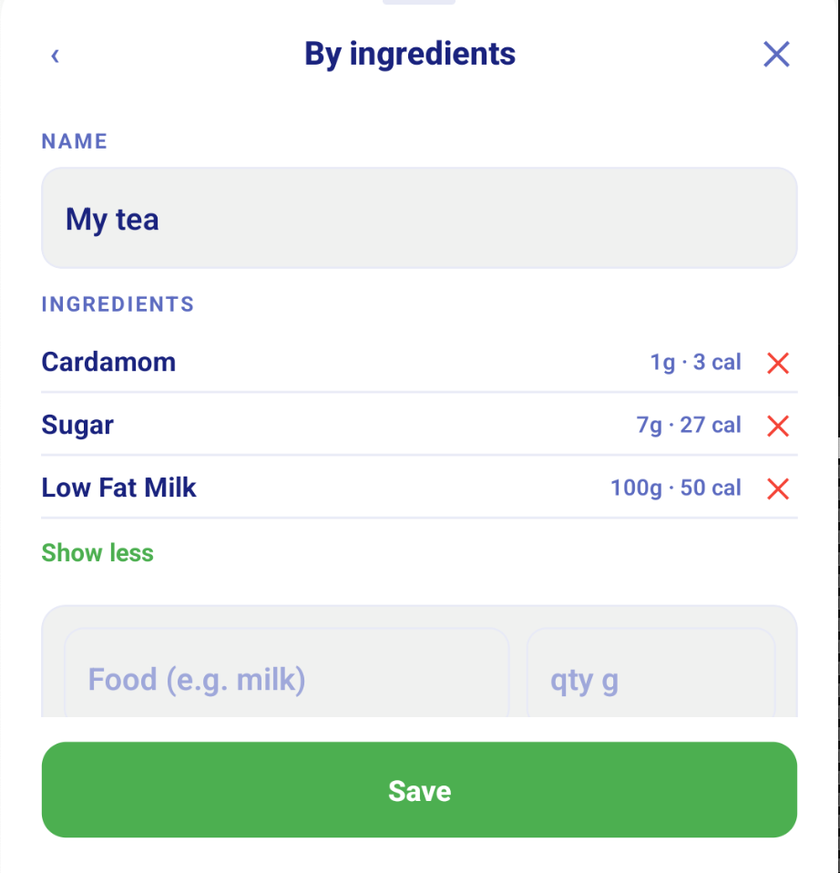
Generic databases guess at what you eat. Build a food once from its ingredients — or straight from macros if you have the label — and every log after that is exact and takes one word. More accurate than the nearest match, and faster than describing it again each time.
Building “my tea” from its ingredients
Day 1
Say it normally
One food per line, several at once, any order — in whatever unit you actually think in.
2 roti
paneer bhurji 1 katori
curd 1 cup
Day 10
It suggests as you type
Type a few characters and the food is suggested from what you already eat. Picking one is faster than finishing the word.
whey
→ Whey Protein · 1 scoop · 120 kcal
Every day after
Your recipe, logged as one word
Once “my tea” is saved, it is a single entry with the exact macros of the cup you actually drink.
my tea
→ My tea · 1 cup · 80 kcal
Entry 04Three weeks, one direction.
Data tells you if it is working.
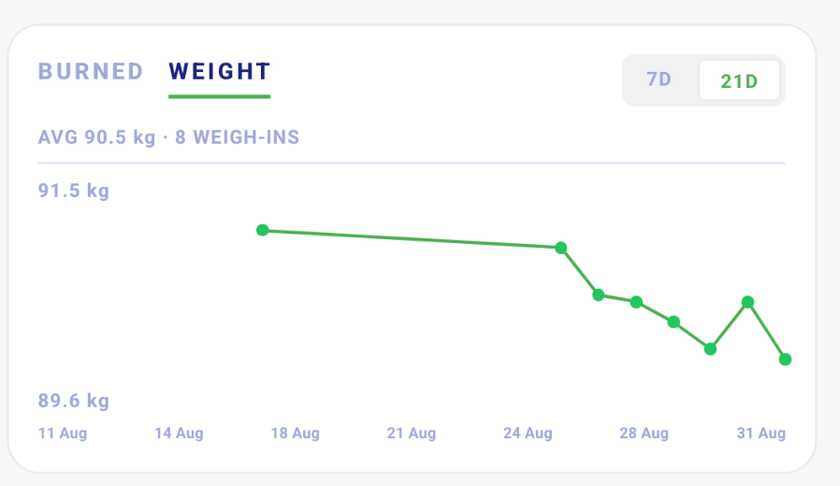
A week of guesswork feels the same whether you are gaining or losing. Weight, intake and burn are plotted over 7 and 21 days, so you can see the direction rather than argue with the scale each morning — and change one thing when the line is flat.
21 days of weigh-ins, unedited
Entry 05Struck from the spec, deliberately.
The best feature is the one we didn't build.
Each of these is standard in trackers, and each is a reason someone quits in week three.
×Your phone number
×A photo of every meal
×A streak you’re scared to break
×Badges, confetti, a social feed
×Fifty features you’ll never open
→A sentence box that understands food
→Suggestions that sharpen the more you log
→Weekly analytics that show which way you are heading
→Weight and burn alongside intake
→Onboarding over in under a minute
Entry 06End of notebook.
Log your first meal in the time this took to read.
No phone number. No onboarding quiz. We ask for what the app needs to work, and nothing else.